Tuesday, 28 July 2020

Rest and Relaxation


Rest and relaxation is something that is different for each person; what might work for one person might not work for another. Often getting rest right can be a journey of trial and error and one I know all too well.

I think that rest and relaxation is important for everyone, but more so in my opinion when you have a chronic illness or disability.

For me rest doesn't replenish my energy store but it just gives me that pause in the day to stop for a while before continuing on with activities, including very low-key ones (which still uses up my energy supply).

I have M.E so resting is important to prevent my health from becoming worse and with my migraines it just gives me some peaceful time to stop and close my eyes and give my brain a break from lots of stimuli.

When I used to rest I used to use my rest time to listen to a podcast or audiobook, but then I realised that for me that was still stimulating me and it wasn't't giving me the rest my body and mind actually needed.

Personally I physically enjoy laying in the quiet, but my mind tends to wonder so I find it hard to settle down properly.

I've now found a good balance with my rest periods which are built into my daily routine to ensure that I get a good balance of activity and rest. When I rest now I sometimes use the time for silent contemplation (as part of my faith). I also do at least one mindfulness meditation each day.

I've found YouTube good for mindfulness meditations as (a) they're free as opposed to a lot of apps that are out there and (b) there's lots of choice on YouTube to find the right mindfulness meditations that suit me as they're a very individual thing. One person may prefer body scanning or progressive muscle relaxation (with this one I find tensing my muscles too painful) whereas for me I enjoy colour meditations, visualisation and breathing exercises. 

The other thing I do when I have a rest periods is listen to relaxation music. At the moment I'm using a couple of apps for this which offer sound effects like sounds of a woodland or rain in the city and I can just lay on my bed with and eye mask on and listen to that for a while and I find it very soothing. It stops my mind from wondering as I can anchor myself and focus on he sound effects. I've also found it good for anxiety and my symptoms too especially pain and my involuntary movements as I can focus on what I'm hearing and add in some breathing exercises and though it doesn't fix or take away my symptoms it does help to deviate myself from over focussing on them. I can also pair it up with some simple breathing exercises which I find helps to ground me and keep me in the present moment.

So my proposal to you now is to spend the next five minuets now to engage in some mindfulness meditation (this is one I enjoy and it's great for when I need to rest and relax but don't have lots of time) and it's one you can do wherever you are right now.

Thursday, 23 July 2020

YouTube Video: What I hope comes from the coronavirus lockdown [CC]

Just a very short video on some of the things that I hope will come out of the coronavirus lockdown for chronically ill and disabled people.

Don't forget to subscribe to my channel to keep up-to-date with new videos! 

Tuesday, 21 July 2020

Birchbox Review: Anthropologie 'One of a Kind'


This has been one of my favourite boxes. I love all the products and I liked the fact that I got a mini face kit in this box with face wash, a cleansing pad and moisturiser. 

KNDR Beauty - Mood Balm in Sorbet Serenity

Full Size, RRP £13

No this is a product I love. I went for the peach shade as it's a shade I don't own compared to the other option which was a pink shade. This product has some techno-wizz where the colour adapts to the pH of your lips to create the perfect shade. When I put it on I love the colour and it came out as a nice natural looking colour on my lips. It's also very hydrating as my lips can get quite dry.

Huygens - Purifying Face Wash

Sample Size, RRP £21

This has a love scent to it. You just need a little to wash your face and it went well with the reusable cotton pads that I've been making. My skin felt cleansed and refreshed after using this product. The face wash also works really well to wash you makeup off at the end of the day. I just took my eye make up off with eye makeup remover and then wet my face and used this face wash and then washed my face with water again, no need for wash cloths or anything.

Elemental Herbology - Facial Moisturiser

Sample Size, RRP £46

This is another product that smells lovely and refreshing. My skin felt hydrated all day (no makeup day). I tried it out under my make up today and it worked really well as a base moisturiser for my foundation and I didn't need to use any primer.

Brushworks - Silicone Cleansing Pad

Full Size, RRP £4.99

I loved that I received a little reusable cleansing pad to go with the face wash in this box. It has a little suction to put it up on the tiles in the bathroom to dry off but it also helps to hold it whilst using it. I like the fact that it reusable and it's easy to keep clean so it's very hygienic. It was nice and gently on my skin and helped to massage in the face wash.

Percy & Reed - Fabulousness Dry Shampoo

Full Travel Size, RRP £6

I enjoyed receiving a Percy & Reed product as I really lie this brand based upon receiving other products buy Percy & Reed in past boxes from Birchbox. Their products are always good quality and this dry shampoo really refreshed my hair and took away that 'my hair needs washing' look. A little spray goes a long way so this travel size is perfect for going away.

Tuesday, 14 July 2020

Keeping occupied when you're housebound

This blog post is the second part of my housebound mini series. It does come from my perspective of someone who is chronically ill and therefore my energy and cognitive function is impaired but it could extend out ideas to others who are housebound due to other illnesses or disabilities or those still in lockdown due to the coronavirus pandemic.

If you struggle with your energy levels one thing I would recommend with activities is to switch them around. So maybe do one activity that uses more physical energy and then let your next activity be something that say for example uses up more cognitive energy. This can help bring better balance to your energy usage if needed and also if needed take breaks, set time limits or have rest periods between activities.

One of the things that I;d hope come from the coronavirus lockdown is a greater understanding of what it is like for those who are housebound. I would also like you to spare a thought to those for whom the lockdown isn't a temporary measure and who will go on to live in their own socially isolated lockdown as the governments starts to lift the quarantine measures. People like myself continue to be unable enjoy to pleasures of a hair cut, coffee with a friend or seeing the latest film. 

I've only been out twice since February which was last week and I was so anxious due to coronavirus but I needed the emergency appointment an follow-up dressing change. I have another dressing change appointment this week and then the community team are starting back up so I will be seeing them as leaving the house for me is exhausting and very difficult at present.

Activity Books & Journals

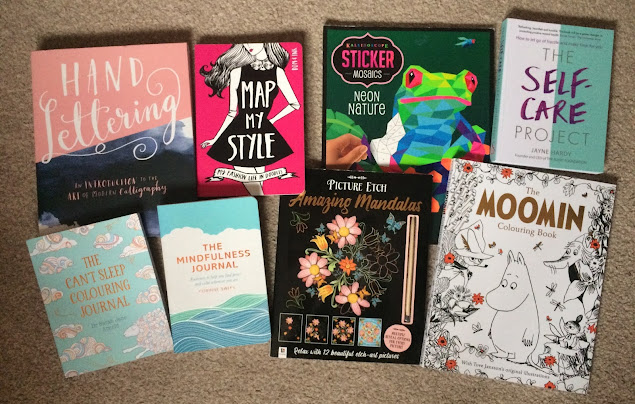
These come in a wide range of options including word puzzle books, sticker-by-numbers, dot-to-dot, colouring books, scratch art and fill-in activity journals on a wide range of topics and much more.

What I like about activity books is that they're easy to put up and put down and can be filled in at your own pace.

Selection of activity books including hand lettering, a fashion journal, colouring books and a stick by numbers book
A variety of activity books that I own

Arts and Crafts

There are wide range of arts and crafts that you can do, some more easy to do than others and you can be sure to find something that takes your interest. 

If you want to get started with arts and crafts or you want to try something new I recommend buying craft kits where you get everything you need with instructions. Here are some places where you can buy craft kits from: HobbyCraft, The RangeThe Works, Etsy, John LewisNot On The High Street and The Arty Crafty Place.

Places such as YouTube, HobbyCraftGathered, and some blogs and Pinterest can give you lots of ideas for crafts and tutorials.

An orange origami fish with text reading just keep swimmingSome types of arts and crafts include:
    A silver wire ring with a yellow bead
  • Hand lettering
  • Card making
  • Colouring
  • Weaving
  • Cross stitch
  • Sewing
  • Embroidery
  • Origami
  • Painting
  • Decoupage
  • Jewellery making
  • Papercrafts
  • Macramé
  • Crochet
  • Knitting
  • French knitting or Spool knitting
  • Felting
  • Quilling
  • Scrapbooking
  • Print making
  • Line drawing
  • Photography
  • Sequin or diamond painting
  • Paper folding
  • Quilling
And a whole host of other things!

Crafting can be something you can get lost in. Creating something that has an end result also gives a sense of satisfaction once you've finished a project. 

My advice is to set a time for crafts depending on your limits, so anywhere from 10 minutes to an hour so you don't get too tired and also remember to make time for tidying up. 

Jigsaw Puzzles

Jigsaw puzzles come in a wide variety of picture topics, I like ones that have a lots going on inside them and they also come in different sizes in terms of how many pieces there are.

When I first started to get back into jigsaw puzzles I started off with 100 piece puzzles; now I've been doing 500 piece puzzles with the aim of being able to do 1,000 piece puzzles at some point.

They really help pass the time away and again can easily be done in short periods of time and can easily be done, left and gone back to.

If you find you enjoy jigsaw puzzles it might be worth investing in a puzzle board so you can safely store your puzzle so you're not overtaking space. It also gives you some portability to do your jigsaw puzzle in different places.

There are also jigsaw puzzle apps which you can do on your iPad or tablet.


Games

Playing a game gives you an opportunity to spend time with other people. Some of my favourite games include Rumikub, Triominos, Scrabble and Bananagrams (which can also be played on your own). These are nice shorter games that don't take up as much time. There's also a wide range of other games on different topics and so much more to choose from. Such as Bobble, Trivial Pursuit (which comes in a variety of interest topics), Cludo, Monopoly, chess, snakes and ladders, The Logo Game, Yahtzee, Pictionary, Articulate and many more. (Check out Waterstones games)

There's also a wide range of electronic games; some you can play on your mobile phone and others on gaming devices. Such as card games, 1010, 2048, Sneezies, Sneezies Match, Angry Birds, dots, two dots, Candy Crush saga, tetris and many more. You can get some electronic games to play with other people too such and dots and boxes and Scrabble.

Letter Writing 

Letter writing can be a huge enjoyable hobby and it can open up your social life especially if you're not able to have visitors. Personally I get huge enjoyment out of getting create and creating letters for people and it's always a wonderful surprise when a letter arrives for you through the letter box.

You can either find pen pals to write to such asking friends you already know if they would like to start up writing to you, or you can join an online group or forum to find pen pals. Spoonie Pen Pals can connect you up with other people living with chronic illnesses or you can search Google for pen pal matching websites (I've just done that now but I didn't know which ones to list here). Alternatively find schemes where there is less commitment such as PostCrossing or the Chronic Warrior Monthly Card Swap.

Reading

Reading is a traditional activity to pass the time. You might want to set yourself a challenge of a list of books you want to get through. In stead of buying books you might want someone to visit the library for you or you could enquire if your local library runs a Home Library service.

If you find print difficult to read you might find it helpful to read on an e-reader where you can read bigger text and change the background colour. You can also obtain large and giant print books through RNIB. Amazon Kindle has a free app which you can download to your phone or tablet. Alternatively you may prefer audiobooks.

Radio, Podcasts and Audiobooks

Brown hair caucasian woman with white headphones holding a mobile phone
The radio can allow you to feel part of a conversation and can give you great company at any time with some radio shows you can also listen to music and keep up-to-date with the latest news and current affairs. There's a variety of different radio stations that suit different audiences and within them different show you can listen in on. BBC Sounds gives access their different radio stations (which you can backtrack and listen to or listen live).

Your phone or tablet should offer you a podcast app which allows you to subscribe to different podcasts. Here are some podcasts links you may find helpful: Google PodcastsApple iTunes Podcasts and BBC Podcasts.

Some podcasts are more set up, such as those by the BBC whilst others are put together by people who broadcast podcasts as a hobby. You can search for podcasts to find ones that cover topics of your interest. Some podcast are chatty ones, or cover current affairs or news topics, some interview guests each episode, others tell stories over a number of episodes and others focus on specific areas of interest.

With audiobooks they may be more accessible to you than reading, or you may find it more relaxing. To buy them can be costly so I'd advised using apps or your library instead. Their is Audible but personally I would recommend RNIB Reading Services which can be accessed by those with sight loss but also individuals who struggle with written text and it is free to access. You can also get audiobooks from your local library and someone may be able to visit on your behalf. Alternatively some libraries run a Home Library service run by volunteers who can find audiobooks and bring them to your home (they can also do this with books).

Music

There are lots of places you can get music, you could download your CD's onto your computer, phone, iPod or MP3 player or download and listen to music through places like Apple MusicSpotify and BBC Sounds - all three can be accessed for free.

Internet & E-Learning

There is so much out there on the internet to keep you entertained.

You can do word puzzles for example Puzzler who bring out different kinds of word and number puzzles.

You can also find an array of blogs to read and also websites that will match your interests, or even find some new interests.

There is also YouTube where you can find a wide array of videos on all sorts of subjects and you can learn new things from YouTube too such as makeup looks or craft tutorials, or 'how to' videos.

Online you can also find e-learning such as languages such as on BBC Languages (which is free) or BSL through British Sign. The Open University also has free courses you can take. There is also Skill Share which offer courses on a variety of topics. If you're keen to learn about graphic design check out what Canva has to offer.

Tuesday, 7 July 2020

Coping with being housebound

At various points in my chronic illness life I've become housebound or have mostly been housebound only going out for essential trips, mostly for medical appointments and the odd special 'treat'. Most recently though I decided to self-isolate as much as possible during the coronavirus pandemic (even though I wasn't on the governments official 'vulnerable list) because of my different illnesses as I know how vulnerable my body is to infections and how if I where to become ill how my body wouldn't be able to cope. Even just getting a cold can lead to me developing a chest infections which at times have lead complications in the past. 

Being housebound isn't easy. It is very isolating and hugely affects my physical and mental health, but I have found ways to mange it.

One of the things that I hope comes from the coronavirus lockdown whereby most of the country had to stay home is that among the public a greater understanding will come for what it is like for people like myself who are housebound and for us this isn't a temporary measure.

How to manage life when you're housebound 


Establishing a routine

One of the most important things I would say about managing with being housebound is establishing some sort of daily routine. Get dressed each day and have meals and snacks at set times and plan around these. My advice it to alternate between activity an rest periods (if you personally need to do this) - this was the advice my Occupational Therapist gave me.

There will also inevitably be good and bad days where you will have to alter your schedule or when appointments clash. Also have a regular night time routine and practice good sleep hygiene. Having a routine gives your day structure and a sense of achievement as it can be all too easy to stay in your pyjamas all day and do very little.

Maybe also build into your routine some time to get some fresh air. or to sit in a place with sunlight. If it is safe and possible on a nice day spend some time in your garden or out on your balcony, or even just sitting by an open window. Or if your home has one sit in a conservatory or sunroom. From my experience this can help you to feel like you're outside and getting some sunlight can help with your body clock distinguishing between day time and night time.

Set goals and make a to-do list

Goal setting and making to-do list makes you feel like you're getting things done. You can make them as simple or as complex as you wish. 

To-do lists can feel a little mundane. Having to write emails, make phone calls, sort through paperwork, tidy-up, get showered and dressed etc but seeing things ticked off again gives you that boost. To make things manageable break things up. Aim to go through just 5 emails at a time, tidy up for 10 minutes then take a break etc and don't forget to set aside time for yourself. And remember, it's okay to ask for help.

You could also make a more uplifting to-do list of things you want to get done like:
  • Write a letter to a friend
  • Make a list of the the TV programs or YouTube videos you want to watch
  • Crafts you want to make
  • Get round to sorting out your wardrobe
  • Paint your nails
  • Learn a new language
  • Start a blog/vlog
  • Read a stack of books
  • Complete a 1,000 piece jigsaw puzzle 
Whatever takes your preference. When you've completed a goal it can feel so amazing. I know I recently decided to make my own heatable eye pillow rather that buy one and now I've made it i look at it and use it with a sense of accomplishment as I'm not amazing on my sewing machine but I made it and  love it.

Most importantly is to congratulate yourself for what you have achieved. 

Engage in self-care

Self-care is so important for your wellbeing and there are so many things that self-care includes so you're bound to find something that works for you.

 It could be doing your nails or putting on some make-up, giving yourself a DIY facial, saving up for something that you really would like to buy, putting on your favourite outfit, lighting your favourite candle, sitting in your favourite place in the quiet for 5 minutes with a hot drink, going to bed early, and so much more - you can read my blog post 30 Self-Care Ideas for some inspiration.

Looking after your emotional wellbeing

Following on from self-care is looking after your mental health which we all have; it doesn't mean that you have a mental illness.

Being housebound can be very isolating which gives you mind room to overthink and when you're living an dealing with a chronic illness it does inevitably wear you down mentally at times.

It's important to talk about how you're feeling whether to a family member, friend or professional. You can find some helplines on My 'List of Charities, Organisations & Miscellaneous Things'.

Friday, 3 July 2020

Review: Homemade reusable cotton pads

At first I was a bit unsure if reusable cotton pads would work but I thought I'd make a few to try out and I'd have to say that I was pleasantly surprised. They where also simple, quick and easy to make.

I've just used one I made earlier today to wash my face and it worked out really well. First I put on cleanser and I used the warm wet cotton pad to wipe it off and then I used and exfoliating face mask and I used the cotton pad to wash that off also.

The cotton pad cleaned well after using it and held together (I was worried it would fall apart). I have very sensitive skin and it was nice and gentle on my face when I was washing my face. What was also nice was that the cotton pad stayed warm as I cleaned my face.

What I might try to do is find some organic undyed cotton yarn to make some more.


I'm defiantly going to keep using them and I'm going to make some more.

They washed really well in the laundry and they stayed nice and soft.

They are great for washing your face or taking off cleaner or a face mask or exfoliator and they stay clean for a few uses as long as you rinse they out well and they them air dry. They only downside is that they're not good with liquids like toner and you ould be able to use them with products like nail polish remover so they don't totally irradiate your need for single use cotton pads.

All-in-all I would defiantly recommend them and if you look back to my last post which is this month's 'Monthly Make' you'll find the crochet pattern to make some yourself. The link to the post is here.

Wednesday, 1 July 2020

July's Monthly Make - Reusable Crochet Cotton Pad with video

This month I thought I'd share with you how to make a crochet reusable cotton pad. No only is it good for the planet (which we all love) it's a super simple and easy project even for beginners. It's made from 100% cotton yarn so they are totally washable so you can use them time and time again and they are lovely and soft on your skin.

Here is a my review on this make

➔ Video tutorial at the end of this post.

Difficulty rating: ★ ☆ ☆ (Simple)


Materials

  • 5mm 100% cotton yarn
  • 4.5mm or a 4mm crochet hook
  • Scissors

Abbreviations (UK Terms)

Puff Stitch directions: Yarn over, insert the hook into the stitch (or magic circle), yarn over and pull up a loop. Do this three times. You should now have 7 strands on your hook. Yarn over and pull through all 7 strands. CH 1 to close the stitch.
There is a useful video here but for this pattern you do it three times and not 5. 

If you are new to crocheting or new a refresher I really recommend to channel Bella Coco on YouTube. Here are some video's for beginners. Sarah-Jayne also have videos for left handed crocheters.

How to make your cotton pad

Round 1

MC. CH 1 to secure to circle then do 8 PS into the MC. SS into the first PS CH. (8 PS)

Round 2

SS into the space between the two PS in the previous round. CH 1 to start then do 2 PS in each space between. (16 PS) SS into first PS CH.

Round 3

CH 1. DC into next CH of the PS and continue to do this around the whole cotton pad. Continue around (31 DC). SS into first CH.


Hanging loop (optional) 

(Added after making the video, I just thought this morning when using my cotton pad that it would be handing if I could hang it up to dry)

To create a loop to hang your cotton pad CH 9 and the SS into the next DC.

To finish

Weave in your ends and the tail from your magic circle and voilá you're done!

Tuesday, 23 June 2020

Social Prescribing: My Experience

I've already talked a little about Social Prescribing and me but I thought I'd write in little more detail.

I was referred to our local Social Prescribing team but my Occupational Therapist when I was in hospital. Upon coming home from hospital I was appointed a Link Worker. It was important for me to have a female Link Worker but everyone in the team is female but my request was listened to.

My Link Worker is the pivotal person in my care in the service and the only person that I've had contact with other than the other yesterday when we was due to have a video chat but she was unwell so a colleague of hers called me to say that my Link Worker was ill and so our appointment wasn't going to go ahead.

At the moment I'm still getting to know my Link Worker and she's getting to know me. We started off talking on the phone and now we meet via video link. (Normal we'd meet face-to-face but due to the coronavirus like with my other care all my appointments are done over the phone or via zoom). We've talked about how I am at the moment in time, where I see myself in the future both mid and long term. My Link Worker has let me know about some possible groups I might be interested in engaging in for the future such as chair-based yoga, a sewing group and an art group.

Sometimes when we meet it's just an opportunity to talk; other times it can be setting small achievable goals and aims that we set together. Our recent aims that we discussed where to:
  • Blog about Social Prescribing  
  • Find creative makes for my blog's 'Monthly Makes' 
  • Do a 1,000 piece jigsaw puzzle (yet to complete, but that's okay)
(On Twitter the NALW really liked what I'd written on my blog as did my Link Worker.)

Everything is based around my own interests which is important and it makes me feel like my Link Worker knows and understands me. It's also part of the person-centred model or care and also seeing things in a biopsychosocial (physical, emotional and social) way. Social Prescribing aims to do as well as following the social model of care (as opposed to the medical model*).

It's helping me rediscover the things I enjoy and setting goals gives me a sense of achievement and it's helping me rediscover and engage in the things I enjoy. 

What's also important to me is that it's not solely focussed on my physical health. Yes that does play a part in what I do with my Link Worker and I can't switch off my health problems, but what's important to me that I set at the beginning of the year was to try and not over-medicalise my life. So by writing about Social Prescribing and finding creative makes to put up on my blog it's helping me to find things to blog about that aren't to do with the medical world. At the same time; reflecting on this now, it's helping me in my head to not focus on my chronic illnesses. Yes I can't escape from my own body, but it's getting me into a different mindset of what to I can focus my mind on (which again is important to me). I am not my chronic illness, it's just one of the portions of who I am.

As well as the goal setting there's also the practical things like emotional support and if needed signposting me to other services or supporting me by acting on my behalf, offering guidance and providing me with information.

What was really nice at the weekend was I received some post from the Social Prescribing team with some information such as coping with anxiety, making a 'Happy Box/Jar', a wordsearch puzzle, support/helpline contact details, keeping active at home and a competition around people's garden spaces - I submitted some photographs on my plants in my room.

I wasn't expecting to write this much so I will bring this post to an end but I would say that it's helpful to have that single point of access person aka my Link Worker and that yes it was my health problems that gained me access to the service but that they don't focus solely on that but me as a person. A bit like a bubble of Naomi: my interests, what's important to me, my care needs and wishes, how I envision my future etc.

The major benefits I find of Social Prescribing is that it supplements my physical health care and offers a different angle on meeting my needs beyond just trying to patch up or fix me medically.

If you have a long-term/chronic illness I would defiantly recommend asking your GP or other care professional in your care team about Social Prescribing.

References 


Tuesday, 16 June 2020

Social Prescribing: Link Workers

In the UK there are over 1,000 Link Workers* working with individuals of all ages. Link Workers come from a variety of backgrounds including community outreach, peer support, volunteering, wellbeing, public health, advocacy, health and social care. (*NALW)

Link Workers have a variety of other titles for example health advisor, health trainer, care navigator, community navigator, community connector, social prescribing coordinator and community care coordinator.¹

In a survey of Link Workers it was found that the main reason individuals when into this type of work was because they [Link Workers] wanted to give back to their community. ²

When a person comes under the care of a Social Prescribing service they are appointed a Link Worker.

As mentioned in last weeks post giving an introduction to Social Prescribing, Link Workers work with individuals who have long-term chronic or complex health care needs including those with mental health problems and individuals who may have become isolated from society.

This link worker is the 'go to' person for the individual and will be the single point of contact allowing individuals to build up a working relationship with their Link Worker in return giving individuals stability, trust and consistency.

A Social Prescribing Link Worker works with individuals to build up their confidence to take better control of their health and wellbeing and this can take place in many forms. Link workers actively listen to individuals to understand what it import to that individual.

Link Workers work with individuals to identify the person's needs in a holistic matters; not just looking at their physical needs but their social, emotional, spiritual, intellectual and cultural needs. This then comes together to develop a personalised action plan identifying short-term and long-term goals as well as identifying any external services or other agencies that the individual could be signposted and referred to.

I'm still getting to know my Link Worker and as well as the practical work we do together there's also an element of supporting my emotional needs too. Many people with chronic health problems will have secondary mental health issues including depression and anxiety which can reduce a person's quality of life ³. At the moment with my Link Worker we have some sort of long-term-ish goals floating around such as groups I can attend possibly in the future but mostly we're just focussing on here and now short-term goals for example writing a blog post about Social Prescribing and completing a jigsaw puzzle and what creative things I can do etc. These things are what are manageable and achievable for me at this present moment. It's nice to have a care professional supporting me that isn't working on the medical model of health care but is seeing me as a bubble of holistic needs and also individually what matter's most to me, like blogging and being creative.


8 Things You Can Do with a Degree in Christian Counseling - Clarks ...

References:

Tuesday, 9 June 2020

Social Prescribing: An Introduction

Social Prescribing is something that I'm benefiting from at the moment and it's something that I'm fairly new too. I have a Link Worker who I'm starting to get to know at the moment and she can support me for up for two years.

Who is Social Prescribing for?

People who may benefit from social prescribing include:
  • Individuals with chronic long-term illness
  • Individuals with complex needs that is affecting their wellbeing
  • Those in need of support with their mental health
  • People who are isolated from society

What is Social Prescribing?

Social Prescribing follows the Social Model of care as opposed to the traditional Medical Model of care used in medicine. (See my blog post on the Social and Medical Models of care.) It recognises that a person's health is not just determined by their physical wellbeing but that other factors play a role also in a person such as social, economic and environmental and cultural factors.

This could include:
  • Lifestyle including diet, exercise, alcohol consumption and smoking
  • Finances including debt and a person's disposable income
  • Eduction
  • Loneliness and isolation
  • Religion
  • Where a person lives
  • Access to the community

Social Prescribing comes from the NHS' 'Long-Term Plan' and it replaces the 'one-size fits all' model of care, especially when it comes to supporting individuals with complex and/or chronic needs the extend beyond their physical wellbeing. For example tackling isolation, accessing the community, confidence building and more. It aims to gives people fuller and healthier lives all round addressing not just physical needs, but social, emotional, spiritual, cultural and intellectual needs.


Working in Partnership

Social Prescribing services work in partnership with a wide range of health and social care professionals as well as with partner organisation including the NHS, Public Health England, the British Medical Association, Community Leisure UK, the National Association of Primary Care, National Voices, the National Academy for Social Prescribing and more. (*NALW)

References:


Friday, 5 June 2020

Opportunities I've taken part in for M.E Awareness Month

So I've been quite busy this month supporting the work done by Action for M.E and the M.E Association.

To start off with I took part in a short video with Action for M.E with two other people, Daisy and Simon, who both have M.E also using our expertise by experience in self-care and coping with the coronavirus lockdown.


As a result of the video BBC Radio Humberside got in touch with Action for M.E asking if I was up to being on their breakfast show so last Friday I did a prerecorded interview talking about M.E, why I decided to take part in the video and also M.E and the coronavirus lockdown.

The link to the radio show is here; it's about 17 ½ minutes into the show for the extended interview.
(Looking back I wish I spoken more about how M.E affects me personally rather than explaining what M.E is.)

Then earlier in the year I submitted my story to the M.E Association's M.E Awareness Campaign which their themes for this year are 'The Lost Years' and 'The Symptoms of M.E' and those have been shared on their website and social media. 

The link to my two articles are below:


#M.EandMe

This was an awareness event I put together myself. Each day something was asked about myself and M.E (and some days non illness related things). For example 'Who am I', 'The difficult aspect of having M.E', 'Happiness', 'M.E in one word', 'Myths and Facts', 'Friendships' etc.

Each day on Instagram I shared that day's response in an Instagram story. I saved them as a highlight. A link to my Instagram account can be found here.

Then on my blog here I went into more detail with my responses and published them as a weekly post:

Monday, 1 June 2020

June's Monthly Make - Aromatherapy Spritz Bottle

This month we'll be making a really easy aromatherapy spitz bottle. You could make one to spray on your pillow at night or to freshen up clothing.

Difficulty rating: ★ ☆ ☆ ☆ (Simple)

Materials:

  • Empty spray bottle (mine is around 250 mls)
  • Filtered water
  • 1 tsp salt
  • Aromatherapy essential oils
  • Card
  • String
  • Pens and other materials to make a a label for your bottle


What to do

  1. Fill your empty spray bottle with the filtered water
  2. Add 1 teaspoon of salt (this helps as a preservative)
  3. Put the lid on and shake 
  4. Add no more than 30 drops of essential oils - less if you're using a smaller bottle
  5. Put the lid on and give it another shake
  6. Make a label for your bottle and attach

Aromatherapy blends

Here a few ideas for what essential oils you might wish to put into your spitz bottle
  • Grapefruit + Orange + Lime
  • Lavender + Geranium + Bergamot
  • Bergamot + Frankincense + Lemon
  • Lime + Lavender + Spearmint
  • Lemongrass + Orange + Peppermint
  • Tea tree + Lemon + Lavender