Tuesday, 22 March 2022

Another little update

Since my last update back in June a lot has happened.

Firstly I had a nice Christmas. It was quiet and low-key which made it much more manageable especially for my M.E. Also over the Christmas period it was good to see my wider family who we don't see often including two of my cousins who I haven't seen in several years.


Health update

My health has been going downhill. My M.E is much more of a challenge; I think it's just been an accumulation of events and my body has struggled to recover before I hit the next hurdle. At first I thought that the state that my M.E is in now would be temporary but months on of feeling permanently exhausted and struggling to function I'm now having to accept that this may be my 'new normal' from now on. However what has help this time compared to previous declines with my M.E is some of the things that I learnt during my hospital admission in Leeds. So now I do more low-level actives, do activities for shorter periods or break them down more and have more and stick to my rest periods and daily schedule.

On top of that I've developed some additional neurological symptoms which my FND neurologist is part of condition which can alter and new symptoms can develop. These new symptoms include speech difficulties, increased muscle weakness and also increased problems with my nerves - the latter two making my double vision worse so I'm now back under the hospital for that. 

I also have a new nurse who is lovely. She's from the 'Chronic and Complex Team' so she's going to support me to try and get some things sorted for me ad come up with ways to reduce my hospital admissions and get community care and refer me and co-ordinate my care and work on my behalf with people like my GP.

Another update is the confirmation of my catheter operation. It's been cancelled a couple of times due to my complex needs but it's now confirmed and I'm due to be admitted on the 12th of April with my surgery being on the 13th - they booked a bed for me so I can travel the day before as otherwise I would have had to travel in the early hours to be at UCLH for 7am on the 13th! I'm nervous but looking for to the benefits having a catheter placed will bring.

I also now finally have a hospital profiling bed at home and my new nurse has prescribed me a hybrid mattress which has air flow in it which is massively helping with my pressure areas and my bed is making life much more comfortable and giving me more independence.


My care package

Yes another update is that I now have my care package from adult social care along with a good social worker and fab PA (I'm needing some extra PA's so hopefully I will get some extra people come along soon).


YouTube & my blog

I absolutely love my YouTube channel. My goal at the end of last year was to get to 100 subscribers and this year I wanted to reach 200 but I'm very almost at 200 subscribers already which is so so lovely. Seeing my subscriber and video watch count numbers grow really does make my day and motivates me to keep going as having a YouTube channel alongside my health problems, especially my M.E is really really hard and at times it is struggle.


I've also had a lot of success with my recent vlog video that I did with my PA Diane and I had a lot of positive feedback and comments and interaction with people. Also the recognition from the M.E Association from this video has been amazing in terms of how my blog and YouTube channel help to raise awareness of M.E.

Blog wise the M.E Association have chosen me to become one of their M.E Champion Bloggers which the recognition of the work I put into my blog and to raise awareness of living with M.E feels amazing.

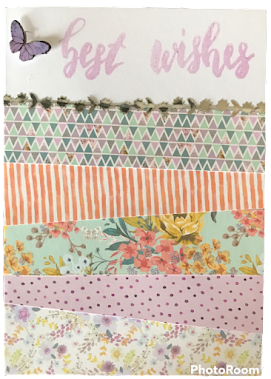
A card with a patterned rainbow coloured in. Below is the original drawn design of the patterned rainbow with a pencil and pen to the side to the image.


Other random updates

I continue to be an ambassador for the Chronic Warrior Collective and I'm part of their 'Extra Card Crew' - sending mail out to those having a tough time. The CWC has also asked me to be part of their 'Artist Crew' to design cards used by those in the Extra Card Crew and with their wider projects and in the recent pack of cards I got from the CWC it was lovely to see two of my card designs have been used.

Tuesday, 15 March 2022

It never gets easier... Eating disorders and what needs to change

Fact: eating disorders have the highest mortality rate of any mental illness

As a teenager I was very unwell entrenched in an inner battle with anorexia. I spent time in several inpatient stays. What saved me was psychotherapy though my eating disorder is still something that stays with me to this day.

On Sunday I heard of another person I knew closely from one of the inpatient units I was in who had passed away. 

I now now 6 people who have passed away from eating disorders, some have passed away from the illnesses itself others have ended their own life. Some where still very much unwell when they passed away others where well but had lasting damage to the body. Even my body has taken a toll from my own eating disorder.

Every time I hear of another life sadly lost it still hits me hard and never gets easier. At 28 I feel too young to know too many young lives taken too soon.

I still feel that more needs to be done to prevent these tragedies. Still far too often early intervention isn't happening; something I've been part of campaigning for for a lot time. More awareness is also greatly needed in places like schools and by primary care professionals such as GP's to aid early intervention and to support people like GP's to manage those who first start to show signs of developing an eating disorder. Also, something I felt was also missing was the care, or lack of, when I was discharged. I was seen by mental health services but they weren't specialists in eating disorders.

There needs to be better access to specialist eating disorder services - I know from personal experience that even when there is a specialist eating disorder service it is hard to get help from them. Often their main acceptance criteria is your BMI which is totally wrong. If you've been discharged from an impatient unit but need ongoing support post discharge your BMI will be within the normal range as well those who are in the early stages of developing an eating disorder will also have a normal BMI and for some types of eating disorders their BMI will remain within the normal range. So BMI shouldn't be used as an admittance criteria for help and support from an eating disorder service.

Goodbye Hayley
I also feel that the media need to be more responsible and thoughtful of how they approach the subject of eating disorders. There are many things that I find unhelpful when I read media reports around eating disorders and I can speak from personal experience when working with the media myself to help raise awareness of eating disorders. Awareness and facts about eating disorders need to be the focus; not a person's weight or a photograph of them when they were quite unwell.

Finally I just want to end this post in memory of Hayley and everyone else who is no long here. Hopefully the inquest for Hayley will help bring improvements for those with eating disorder and something will come from her loss.

Tuesday, 8 March 2022

How my PA supports and enables me | YouTube video [CC]

Diane is my PA (Personal Assistant). I filmed this vlog over 3 days to share with you the many different ways in which Diane supports and enables me to live my life, from helping wash and dress, to going out and getting coffee to taking me to hospital appointments. Diane has been my PA for nearly a year now and we get on really well which is what you need from a PA as you spend so much time with them. We've never yet run out of things to talk about and we can have a laugh about things too. Even though we do seemingly fun things like going for coffee it's benefitting my social and emotional wellbeing as the vast majority of the time I'm housebound (the week filmed was very very unusual as I went out twice that week - normally I only go out once a week max). Also I need Diane's support when I do go out because of my medical needs such as when I had a seizure at the hospital (probably because my body was exhausted from leaving the house). Also with Diane being my PA for a while now she has become attuned to my routine and care needs from what toiletries I like to go together to managing my health care needs like when I have seizures or pass out. 

Before Diane came along I didn't know anything about the role of a PA and now I can see what a rewarding job it can be as Diane supports and enhances my life so much and in so many ways, even if it is just enabling me to enjoy a nice long hot bath. Becoming a PA isn't for everyone but it's a career I would encourage people to look into.


Click on the video to watch on YouTube

If you haven't already subscribed to my channel and you would like to (you don't have to) but it would be lovely to see you become a new subscriber and every time I do get a new subscriber it really does make me happy as I love my channel but being a disabled YouTuber it is a huge challenge.

Tuesday, 1 March 2022

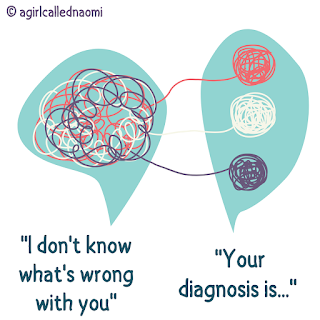
Living without a diagnosis

When I first started to become unwell no one could tell me what was wrong with me; my symptoms where just 'medically unexplained'. At first I just thought things would be temporary. However as time went by my symptoms continued and worsened and as they did and I still received no answers I started to question myself. Names for illnesses floated around but nothing was certain and my symptoms remained 'medically unexplained'. It frustrated and upset me as what I was going through was real, especially the times when I wasn't believed or was told my symptoms where psychosomatic or 'all in my mind' which lead to receiving poor care from professionals.

Living without a diagnosis was so hard as when I went to the hospital or saw another professional like my GP or when I was asked what was wrong with me I had no answers to give. It was so difficult on many levels as what I was going through was real but it wasn't backed up by a diagnosis. Having no diagnosis to give also made it hard when I was applying for ESA and PIP - government benefits for when you're too unwell to work or to cover the extra costs incurred due to having a chronic illness/disability. Having no diagnosis also meant that I got little in the way of treatment for my symptoms. I would have a seizure but paramedics where reluctant to give me the medication I needed or my GP was hesitant to prescribe medication for my symptoms as there are no prescribing guidelines when you don’t have a diagnosis or would have nowhere to refer me to for specialist care. Other aspects of my 'medically unexplained symptoms' where also met with lack of surety such as believing that my joints where actually dislocating or I was having the amount of migraines I was claiming to have. With regards to my high levels of fatigue my GP on a number of occasion did diagnose me with 'Post Viral Fatigue Syndrome' but I was told that I would soon recover, but I never did.

It wasn't until the July 4th in 2017 that I was told I had M.E. (Myalgic Encephalomyelitis) and Functional Neurological Disorder by my neurologist Professor Mark Edwards. Finally I could stop blaming myself for what I was going through and the symptoms I was experiencing were real and not imagined or 'all in my head'. I had a name to give to people to explain why I was having this symptom or that symptom. Further to that my neurologist noted my hypermobility and referred me onto a rheumatologist and later I would be diagnosed with Hypermobility Spectrum Disorder/Ehlers-Danlos Syndrome (over the years professionals have used both HSD and hEDS but there is little difference between the two). 

Looking at that particular diagnosis it took me back to my childhood and there I can now clearly see the signs of my EDS then. EDS is a hereditary connective tissue disorder; it was something I was born with but as often the case with EDS many people with the condition don't get their diagnosis until they are much older. I was born with a spinal curvature, hyperlordosis where my lower spine acutely curves inwards. I'm no stranger to back pain and joint pain due to my hyperlordosis but growing up my joint and related pain was always dismissed as 'growing pain' but now I can clearly see the signs of my EDS. I was a dancer and being hypermobile I used it to my advantage despite my pain. But again looking back my "growing pains" where dismissed as that and no one looked further into it.

I must say that many people are hypermobile to one degree or another and a lot of these people use it to their advantage, especially dancers, gymnasts and athletes. However the vast majority of those who do have hypermobility do not have EDS. Hopefully one day like the other forms of EDS a genetic marker will be found to help give people like me diagnosis, especially treating the condition early on such as when I was younger instead of leaving it until I was older and had developed many complications as a result of my EDS.

Coming to the present day I now have other diagnosis, often ones that come secondary to my 'main' illnesses, such as PoTS (Postural Orthostatic Tachycardia Syndrome).

Now I have a diagnosis (or a few as the case is now) means I can get the care I need as generally when you have a diagnosis you have NICE guidelines to tell professionals how to treat and care for me. I've also found that now I have names to give to people like when I dislocate a joint I can explain that I have EDS or my extreme fatigue is because I have M.E. and it’s more than ‘just feeling tired’. Most of the time my symptoms are now understood, though I do find myself in situations where I'm not believed because my illnesses are not that well understood. On the whole though now I have my diagnosis' things are much better and though my health isn't great I'm getting the care and support I need compared to the time when my symptoms where 'medically unexplained'.

Tuesday, 22 February 2022

Good care matters - my experiences of receiving care

I've had support from carers for several years now and over that time the care that I've received has been varied from wonderful right down to horrendous experiences of care so I've come to realise that good care matters.

Last week my PA was on leave and my Dad and stepmum were away for a few days and I had to resort to using a care agency again to pop in, check I'm okay and to help me out with tasks including getting washed and dressed, taking my medication and preparing meals and drinks.

I was quite anxious to say the least about having a care agency as the last care agency I had when I first got my care package was awful. Half the time I wondered why many of the carers where woking in the job and I never received the amount of time I was allocated and I was often rushed, essential tasks missed like not being given my medication or having a drink. Carers were always consistency late too, especially at bedtime as bedtime is when I'm at my worst. I also need go to bed fairly early so I can get as much sleep as possible to allow my body to function during the day. All-in-all it was making me ill and I was miserable and though I needed the care I couldn't take putting up with this "care" any longer. I was then approved to have my care provided through direct payments which allowed my previously privately employed PA to come back and continue to work as my PA. Currently I'm trying to get additional PA's to my care team as I need care 7 days a week and also to have different PA's to cover for each other for when one is ill or on holiday.

Anyway last week for a few days I had a different care agency. I couldn't have faulted the care I received. I felt that my care needs and wishes where fully met and I was treated with respect and individuality as a young adult who just so happened to need a little help to be able to live their life. I was allowed to choose how I spent my care such as having a bath over a shower, how I like to have my hair washed and my other routines that I like when getting washed and dressed or little things like how much cumber I had in my sandwich. Little things like this when you need a hand with things matters and it makes me feel empowered especially because I need help with things that most people my age can do on their own. For example with my bath I can't bathe on my own but being able to chose what products I use and the order of at one point I'm wanting my hair washing, or when I wash my face or when my body is washed gives me as much control with support and enablement.

My illnesses don't yet have a cure and at 28 it can be difficult to need help to manage different aspects of my life. However good care helps me feel just that little bit more in control of a life I have little control over. Good care make me feel better an it improves my quality of life just that little bit better too both physically, socially and emotionally.

Receiving good care has made me realise what an amazing job care work can be. For someone needing care though it can be hard unfortunately to find good care at times. Thankfully most of my experience of receiving care has been good but like I mentioned I've had my fair share of bad experiences. Not just with community care but when I've been in hospital too and I've heard from home care workers their own experiences of seeing poor care from other carers. Often I've found it depends upon the care agency. The agency I had where I had an awful experiences there where some good carers but on the whole most of the "carers" to me seemed to be working in the wrong industry.

I've always felt and said that carers need greater recognition for what they do as well as to be paid more than just the national minimum wage to reflect the big difference they make to many disabled and chronically ill people's lives. I don't get how someone working in a supermarket can earn more than a carer or a personal assistant. Personally the latter is a much more worthwhile job.

I want to raise more awareness of the role carers play. To help with this I plan to vlog some of what my PA supports me with to give people an insight into the role and the variety in what the job entails. Such as today (Monday 21st) my PA has made my breakfast, supported me to wash and dress, taken me to a nurse appointment for some pre surgery tests. We then went for a drive-thru coffee and came back to get some lunch. How's that for variety! I wish I'd filmed today but hopefully when I have another day like today I can film it but at the moment I've not been well enough to be able to do the editing for YouTube videos so I've been using some videos I made a while back and I'm feeling wiped out from leaving the house.

Tuesday, 15 February 2022

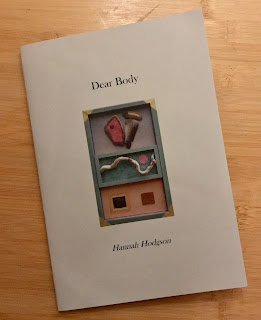
'Dear Body' by Hannah Hodgson - Poetry review

Rating: ★★★★★ out of 5!

‘Dear Body' is a poetry pamphlet written by Hannah Hodgson. It was Hannah herself who got me interested in poetry through her YouTube channel where she shares videos of book and poetry reviews as well as sharing her own story of living with a life limiting illness and being a palliative care patient and hospice user.

Hannah's YouTube channel is linked here.

I've started to read other poetry but 'Dear Body' was the first piece of poetry that I actually understood and I liked the the different styles in which Hannah had written her poems to exaggerate the topic of the poem, such as the poem 'Processing' where there where very spaces in-between each word to emphasis the difficulty in processing thoughts due to poor concentration and focus.

As well as 'Dear Body' containing poetry I could understand and grasp it was also a collection of poems I could relate to on a very personal level so the poetry collection was even more emotive. It help creatively speak out my own thoughts, feelings and experiences of living with challenging complex health problems. Of how disability is visually left out because it is not a picture of beauty, the marks and scars left on ones own body, the frustrations of living in a body that is broken and a mind that struggles to function, the invisibility of our symptoms and so much more.

Hannah also guest blogged for me a while back and in her post she shared one of her poems 'Invisible'. The post by Hannah which was shared for World Poetry Day can be found here.

If you're interested in poetry or are new to poetry, or to those who are chronically ill or disabled and want to read something relatable then I would defiantly say that 'Dear Body' is a good poetry pamphlet to turn to.

You can purchase 'Dear Body' from Wayleave Press for £5 - link here.

Tuesday, 8 February 2022

Dealing with boredom when I'm having a bad day

The reality of severe M.E
I have severe M.E; it's a neuro-immune condition that has many different symptoms. M.E affects about 250,000 people in the UK of all ages and around 1 in 4 people will be severely or very severely affected.

I have variable good and bad days. On my bad days it can be a real struggle; my pain levels increase and I'm much more sensitive to light and sound. My mobility is also even more reduced also side worsened orthostatic intolerance and autonomic issues mean that I have to spend most of my day laid down. My cognitive function and brain fog is also more of a challenge. All these things are present most days but they're more pronounced on my bad days.

The things I can manage to do on a good or even average day is reduced so what I do to entertain myself is more challenging so I have to find ways to avoid boredom whilst managing my different symptoms and trying to also distract myself from how I'm feeling not just physically but emotionally too.

One of the main ways that helps me deal with my boredom on my bad days as I lay in a dimmed room is listening to audiobooks and podcasts on a really low volume and I often put in my noise cancelling earplugs to block out the painful background noise and then put on my noise cancelling headphones or my headband earphones so I can just have the low volume of my book or podcast playing to me. I also like options from the book I'm listening to and then the wide variety of different podcasts as I can struggle to focus on one thing for too long sometimes. Especially with podcasts there's lots of different one to choose from in terms on genre and topics whether it be a series or something like a documentary or a chatty style podcast and with these each episode has a different focus. This helps as generally podcast episodes aren't too long so that helps me with my concentration difficulties. 

Usually I can tolerate listening to books and podcasts but if I can't because for example my noise sensitivity is too much or I can't concentrate or I just want something different to do I use my imagination. I play games in my head especially Carcassonne, a building strategy game. We have the actual game which I love playing when I'm able to so it's fun to play it in my head and work on my strategy for when I next play it with other people. Tetris is another game I play in my head. Something else I do with my imagination is to plan and build a house and design the architecture and then the different rooms and then put together the interior design.

I also enjoy mindfulness meditations which I do daily during my rest periods and again I like the variety of the different mindfulness meditations that are out there from visualisation meditations to breathing exercises.

The last thing I do in my mind is plan out future blog posts and videos for my YouTube channel.

Tuesday, 1 February 2022

Super easy scrap paper handmade card with video tutorial

Card example
This is such an easy card to make and can be adapted for different occasions as well as the different craft supplies you own plus putting your own twist on style of the card.

Difficulty rating: ★ ☆ ☆ - Total beginner


What you will need...

  • Blank card and envelope (any size)
  • Co-ordinating patterned scrap paper (or card) - perfect if you're coming to the end of a paper pad (your paper needs to be longer than the width of your blank card)
  • Sentiment - this could be a stamp, sticker, die cut, hand lettered etc
  • Either a paper trimmer or a ruler and pencil
  • Scissors
  • Glue - liquid craft glue or just a normal glue stick
  • Border sticker or alternatively you could use ribbon, washi tape, a very small strip of plain or shiny or glitter card or something similar

How to make the card...

1. Cut your scrap paper into strips

Cut your scrap paper into 2.5cm (1 inch) strips. You'll need around 5 or 6 strips depending on the size of your card and the sentiment at the top.

If you're using a small blank card you may want to cut thinner strips or vice versa with a larger blank card you may want to cut slightly wider strips, say 3cm unless you want a wider variety of patterned paper strips.


2. Place your sentiment at the top of the card

You don't have to place your sentiment first but I find it helps me to work out the placement of my paper strips and also the border that I'm going to add between the top paper strip and the sentiment.


3. Work out what order you want to place your paper strips

Before gluing down your paper strips play around and work out what order you would like to place down your paper strips. 

The first strip of paper is placed along the bottom of the card and the rest of the strips will be placed at an angle.

Tip: Take a photo so you can recall what order your strips will be placed in


4. Glue down your paper strips

If you're using liquid glue, glue down along the bottom of your card and also up the sides of the blank card front. 

On the first strip of card place a line of glue along the top and lay it along the bottom of the card.

With the other paper strips glue a line along the top and bottom.


5. Add your finishing touches

Along the top of you last strip of card place a border to finish off. This could be a border sticker either one with a pattern or a plain or glitter border sticker. Alternatively you could use ribbon, thin washi tape or a very thin strip of metallic or glitter card as a few ideas.

If there is room you could also add an embellishment such as a name, a sticker or like I used a 3D butterfly card topper. 


Ways you can adapt this card...

Some cards I have made as shown in the video tutorial below, other times I have used a sticker or die cut sentiment or used alphabet stickers or stamps to personalise the card.

I've also used different sized paper strips depending on the size of the blank card I'm using.

Another thing I have done is to completely cover the blank card front in paper strips and then mounted on top a sentiment which I had stamped onto white card mounted onto coloured card that complimented the colour of the paper strips and then stuck it on the card using 3D adhesive foam. 

The many possible ways you can finish or adapt this card are endless!


Video tutorial

Tuesday, 25 January 2022

Kintsugi 金継ぎ - Acceptance of physical & mental brokenness

I've been listening to a mindfulness meditation series on Headspace about self-compassion. In each meditation the narrator gets you to repeat to yourself the following affirmations:

"May I accept who I am", "May I love myself as I am" and "May be at ease with who I am"

At first I found this hard to really take in. I don't love, accept or feel at ease with myself. Part of this was about my disabilities as it's taken me a long time to accept my chronic health problems into my life. My disabilities have made it hard to love myself as I am now and equally to be at ease with myself and my disabilities and all that comes along with having disabilities and chronic health problems.

It can be hard to love a broken body and mind; especially one that can't be fixed. So in the absence of being able to fix my brokenness I must learn to love myself as I am and accept my brokenness and also be at ease living inside a broken body and mind.


Kintsugi, 金継ぎ, is the Japanese art of putting broken pottery pieces back together with gold — built on the idea that in embracing flaws and imperfections, you can create an even stronger, more beautiful piece of art.

Photo of a light green bowl which has been broken and glue back together using a gold coloured glue
The Kintsugi bowl I made

Something I did a while back with my therapist was to make a Kintsugi bowl. It was a kit my therapist had bought for me, which was such a lovely3 thing for her to do for me and was so kind of her. 

The small bowl was whole. I then had to break the bowl, which I tried to do artfully, ensuring that the bowl was broken in a particular way. With my own physical and mental brokenness there was no artful way in which I have become broken.

Once I felt happy with my artfully broken bowl I set out to fix it, but to fix it in a way that would make the bowl more beautiful for having been broken. I mixed up a combination of glue and gold powder to make a golden glue to piece back together my now broken bowl. When I reflected with my therapist about how I glued to bowl back together my therapist pointed out to me about how I glued the bowl back together (therapists have to analyse everything (!) but it can be helpful at times and even I'm analysing in this post!). I didn't rush putting my broken bowl back together I carefully applied the glue, like how I care for my own broken pieces. I applied the amount of glue that I wanted. Remembering back to this therapy session I remember how I wanted enough glue so that it was visible and showed through the cracks of the differs ceramic shards. It was a carefully chosen process. With my own brokenness some of my cracks are invisible; my pain and exhaustion and struggles with mental illness cannot be seen but at the same time I also have scars on my body that are visible but I choose to hide.

The whole process of braking the bowl and then putting it back together made me think of my own body and mind's brokenness. I feel like throughout my whole life I've been broken in one way or another and smashed apart as I've gone through my life both by other people around me but also due to physical and mental illness.

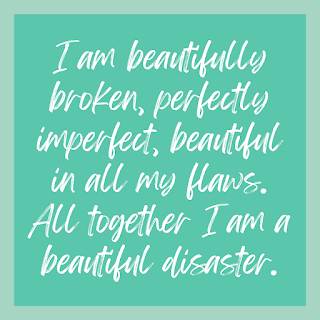
A turquoise background with white text in a handwritten like font. The test reads "I am beautifully broken, perfectly imperfect, beautiful in all my flaws. All together I am a beautiful disaster."
In therapy over the years I've often stated how I feel that I'm broken into a million pieces and 'too broken to be fixed'. Unlike how I artfully broke the bowl I've never had any control over how my mind and body has broken and because of this it's been difficult to piece myself back together. Therapy I would say is the thing that's held my brokenness the most over the years. Sure inpatient and day patient treatment (both psychiatric units and medical admissions) has kept me safe and in all honesty alive, but even my times in hospital have added to my brokenness from so of the things I experienced as a patient. Then there is the medication I take both for my physical symptoms and also my two psychiatric medications. Medication just enables me to manage my physical and mental health symptoms to allow me to just get through the day. 

Therapy isn't for everyone but for me over the years therapy (most of the time) has been what has held me together the most to stop my broken pieces being blown away in the wind.

Going back to the kintsugi bowl I did with my therapist a few months ago massively helped me. It was such a simple thing that me and my therapist did together but it really helped me to accept my physical and mental brokenness but how in time I can piece my life back together. I will never be whole and unbroken again; I will always have to deal with being physically and mentally unwell. However out my brokenness and with time my broken pieces will come together and what I've learnt over that time in life and in therapy I can turn my brokenness into some better and create something positive. I can use my brokenness for example to help others, like I hope I do through my blog and what I share over on my YouTube channel and also through things like voluntary work and the support I give to my friends and others around me and hopefully in the future when/if I'm able to work. I can use my lived experience to my advantage and turn negatives into positives which I feel I already have done.

As well as helping others inwardly I can turn my brokenness into something beautiful. There is no cure for my physical and mental illnesses but as I was putting my kintsugi bowl together I realised that in my own self I can develop a better attitude and learn to accept my brokenness and learn to love myself including the broken parts and also to live and be a ease with my brokenness. By doing this I can start to feel whole, glued back together with gold.

I keep my kintsugi bowl next to my bed and put random bits on bobs in it but every time I see the bowl it reminds me that in time my body and mind can become like that bowl, broken but whole held together with something beautiful.

Tuesday, 18 January 2022

Book review: 'Me Before You' by Jojo Moyes *Spoiler alert*

Front page of a book. Large text reading the title 'Me Before You'. A black silhouette of a woman releasing a bird into flight. Below is the authors name 'Jojo Moyes' dotted around the image are quoted reviews of the book.

Rating: ★ ★ ★ ☆ ☆ 

The plot of the story is basically Lou, a young woman in her 20's who is looking for a job after the café she worked at closed down. After many failed attempts at finding new employment Lou takes on a job caring for Will who became a quadriplegic after being hit by a motorcycle. Following his injury Will struggles to adapt to becoming a quadriplegic.

It's a romance novel, a genre I'd never read before. If I hadn't of heard Jojo Moyes sharing that it was a romance novel in an interview with her at the end of the audiobook I wouldn't have instantly put it down to be a romance novel. Saying that though there was an element of romance as Lou and Will over time grew feelings for each other as the story unfolded.

I think the author got it sort-of accurate on Lou's perspective as she get's used to caring for someone with a disability as someone new to this type of work. For example how at first Lou and Will struggle to connect with each other and Lou getting used to taking on a care work role such as managing Will's medications and the complexities of his health and how she feels unsure of what she is doing. Then on the flip side Will getting used to having Lou as his carer. I also feel that the author did her research on the affects of spinal cord injuries and also their care needs such as at one point in the book Will develops a fever and due to his injury he is unable to control his body temperature and required medical intervention.

I think the author got it accurate sort-of such as how at first getting used to having a new carer and also for Will how it feels for him needing someone to do so much for him and the loss felt when you become disabled which I could relate to. As well as this the emotional response people have towards their acquired disability. I think it was positive how Lou tried to show Will that there’s a life you can still live when you have a disability.

Despite Lou's best efforts to help Will see that he can have a life worth living despite his health problems Will remains deeply unhappy and wanted to end his life in Switzerland with the organisation Dignitas. I felt it was very brave of the author to bring into the story assisted dying and the mix of feelings and reactions from people Will, his family, Lou her sister and the quadriplegic message board. 

I liked how though most of the book was written from Lou's perspective that parts of the book were in the view of other characters such as Will's parents and Lou's sister however I would have like a chapter written from Will's perspective.

All-in-all it was a good book and I would like to see the film version and also read the book sequel at some point but I don't feel in a rush to want to read it.

Tuesday, 11 January 2022

Why the plastic straw ban is still a big deal

It's been a long time since the straw ban came into place but this issue still affects me so much.

Plastic straws are an essential aid for me; without them I'd struggle to drink and the vast majority of straw alternatives are not suitable: injury risk, allergies, not positionable, too expense, hygiene etc - see the chart below. I have floppy weak wrists so I can's tip a cup towards me; I also have to use lidded cups because of my involuntary movements. When I'm in hospital I hate being given the beaker cups with a spout lid.

Everyone I know who has a need for plastic straws always re-uses them; they are never 'single use'. When the ban came in I stocked up on straws so I have plenty to keep me going for quite a long time. I do have some silicon straws that can be spilt down and reconnected which (a) makes they great to clean but also (b) these are hypoallergenic silicone but the issue with these straws are that I can't position them to bend. I have to spend a lot of time laid down so I've perfected my ability to drink in this position and bendy plastic straws are the only option in this situation.

One thing I don't get is that if I say ordered a frappachino it comes in a plastic cup with a plastic lid, or if I buy a Diet Coke it's in a plastic bottle (which I still need a straw for) or if I order coffee and have a fruit pot the fruit pot comes in a plastic pot and I may also be given a plastic fork and if my drink is to-go it has a plastic lid. Yet whenever I ask for a straw it's paper or at the café at my hospital they provide hard biodegradable plastic straws that (a) melt in hot liquids, (b) if I jerk I jab the roof of my mouth and both the paper and plastic straw aren't bendable. I do try to carry around some straws but sometimes I forget to bring some with me or I don't plan to get a drink. Also where is the recycling points for my plastic bottle or fruit pot or paper cup and straw?!

So as you can see the straw ban though old now is still a big deal for me and probably many other disabled people.

Tuesday, 4 January 2022

Positives of 2021 and plans for 2022

It's so easy to dwell on the challenges of the past year. Thinking about how my M.E has worsened and whether this new state my M.E is in is now my new normal or how my FND has progressed with new symptoms developing and the difficulties I've had at times to access care like the migraine clinic that I've been waiting to see for about 2 years. Then there was the surgery I'm desperate to have an I could have had it but I need to have it in an NHS hospital as I need ITU/HDU on standby due to the complexity of my needs and no one can tell me when my surgery will happen. Then there's the dwelling on how the following year will be and the challenges I will undoubtably have to deal with ahead of me.

Dwelling on the challenges and negatives is so easy so what I've been doing with my therapist is thinking about the positives of this year no matter how small and also what I've achieved this year. This has really helped me to see this year much better; it doesn't take away the challenges but it's made me see things in a different and brighter way.


So, what's been positive in 2021?...

  • The first thing is how I've exceeded my goal of getting 100 subscribers to my YouTube channel. At the time of typing this it's not the end of the year yet and today checking on my channel I have 128 subscribers!
  • I've also exceeded to number of books I planed to listen to/read on my Good Reads reading challenge.
  • I've supported and participated in different opportunities. I've written articles for both the M.E Association and Action for M.E and also supported and been part of some of the campaigns they've run this year. I'm now an M.E Champion Blogger for the M.E Association. I also have become and ambassador for the Chronic Warrior Collective and joined their Extra Card Crew and supported their work.
  • I feel so much gratitude towards my friends and pen pals for all the messages and mail I've received this year.
  • This year I finally got a care package after years of trying and I now feel supported by our local adult social care service. I have a very good social worker, and a fab PA. Plus also in my care I have some good doctors and my link worker from the Social Prescribing team is great. Also just recently I've been assigned to a lovely advanced nurse practitioner from the 'Chronic and Complex' (which is how they alway see me when I'm in hospital) team who's supporting me with my care. I feel that in terms of my health and social care the past few months my care and support has really come together finally and getting this care I feel more positive about 2022.

Projects and things I want to do in 2022...

  • I what to buy things from smaller or independent shops as much as possible more this year
  • I want to commit to my photo journal 
  • Also I want to stick with my 1 Second Every Day project and come up with some creative video clips (as my life isn't that interesting which I think is why I stopped last year)
  • I want to finish my BSL online course
  • I would love to learn how to braid my hair
  • I want to continue growing my blog and YouTube channel
  • And finally hopefully I'll have my surgery soon and some extra PA's too!