This involves looking after our bodies including health, nutrition, sleep, rest etc.
Some examples include:
Going for a walk
Having a bath/shower
Getting enough sleep and resting during the day
Eating a nutritionally balanced diets
Drink plenty of fluids
Take a rest or nap during the day
Emotional Self-Care
This involves emotional literacy, emotions, increasing empathy, managing stress and anxiety, developing compassion. Some examples may include:
Writing a gratitude journal or creating a gratitude jar
Be more kind to yourself
Do a stress management course
Making time for reflection
Working on developing emotional literacy
Being aware of ones own boundaries and saying 'no'
Intellectual Self-Care
This involves learning new things, thinking and creativity.
Some examples may include:
Practising mindfulness
Journalling
Reading
Learning a new skill
Doing a digital detox
Do a colouring or puzzle book
Social Self-Care
This involves having a supportive network of family, friends and others such as colleagues at work who you trust and can turn to when needed. Having a supportive and caring network of people around you helps build up a sense of belonging and connection. Some examples include:
Join a social group, such as a local craft group
Asking for help when needed
Meeting new people
Spending time with others
Speak with friends, either send them a text, call/video call them or even send them a letter
Go out with people such as cinema or coffee dates
Environmental Self-Care
This involves being organised, having a clutter-free space to work at either for work or hobbies, a tidy room for rest and sleep, your home environment, a tidy care. Also minimising waste and monitoring home mine time we spend with technology. Some examples could include:
Having a declutter of your home or work environment
Having a wardrobe clear out
Recycling as much as possible
Monitoring technology time
Tidying up after yourself
Maintaining and clean and safe living environment
A Quaker Meeting (my faith)
Spiritual Self-Care
This involves your beliefs and values that are important to you and that guide you in the way you live your life. This could include pursuing goals and practises that help you develop your spiritual awareness. Some examples could include:
Meditation or mindfulness
Having a reflection journal
Volunteering
Spending time in nature
Preyer, either alone or with another person
Find a place of worship where you feel comfortable
Financial Self-Care
This involves being responsible over your finances such as daily living expenses, income, insurance, savings etc and having a good relationship with money. Some examples could include:
Knowing where your income in going in
Knowing what and when your outgoings are due
Paying bills on time
Keeping insurances up-to-date
Opening a savings account and saving money more wisely
Using an appt or finances book to get track of ingoing and out going expenses
Self-care is looking after your mind and body to support your physical, social, emotional and intellectual wellbeing. We could engage in self-care by eating healthily, exercise like going for a walk, attend an activity group, talk with a counsellor or take time out of the day of a spot of mindfulness. The dictionary definition of self-care is:
Self-care is good for us as it empowers us to take control and look after ourselves and be more self-reliant and become resilient both interns of of physical health as well as our mental health. Self-care also helps catch problems early and prevents problems from getting worse. You don't need to be ill to engage in self-care, intact it's better to engage in self-care to prevent problems occurring int the first place, especially when it come to our mental health.
This week marks Self-Care Week 2019. Self-care is a vital tool look look after not just jour emotional wellbeing but your physical, social wellbeing too. This week I'm going to post some self-care info to help you look after yourself. I will be posting about self-care boxes, mindfulness activities, yoga and other ideas for looking after yourself to get you going on your journey to self-care.
"Postural Tachycardia Syndrome (PoTS) can be a life altering and debilitating health condition. Simply standing can be a challenge for people affected by the condition as their body is unable to adjust to gravity. PoTS is due to an abnormal response by the autonomic (automatic) nervous system ad is characterised by orthostatic intolerance (the development of symptoms when upright that are most relieved by lying down). Symptoms include palpitations, lightheadedness, fatigue, sweating, nausea, fainting and headache, ad are associated with a persistent increase in heart rate from the lying to up right position." - PoTS UK
I got a diagnosis of PoTS this year. I struggle to stand for even short periods of times so I often need a wheelchair to help me manage my symptoms (alongside my other illnesses). When I stand my blood pressure drops and my heart rate increases to try and compensate. For me my PoTS goes alongside having M.E. and my hypermobility disorder which is very common. The PoTS UK website has really helped me to understand the condition as well as helping me find ways of managing the condition. Though there is no cure for PoTS it can be managed by lifestyle changes and for some people alongside this medication. For anyone interested in wanting to know more about PoTS or has the condition themselves or if you are affected by the condition such being a carer for someone wit the condition or you are a care professional I'd defiantly recommend checking out the PoTS UK website.
My health problems are real, even though other people can't see it and what others do see, like my wheelchair or crutches or orthotics is on a tiny fraction of what I'm dealing with. Things like pain and fatigue and all my other symptoms, like a dislocated joint (unless I'm waving around a x-ray), migraines, hypersensitivity, depression/anxiety and autistic traits can't be seen, only invisibly felt or experienced. "You don't look sick" I've lost count how many times I've heard that over the years. It's not a compliment when someones says those words to you. Those words I find so funstrating to hear as I wish I could hand over a box of all my invisible suffering and it makes it hard for your suffering and trying to have your ill health taken seriously. "Looking well" takes a heck of a lot of effort and it can be a burden to seem "okay" to the outside well and it's almost something you have to do because you have to live out your life through your suffering. If you spent your days acting out your internal sickness you would never get anywhere. Often care professionals don't take your symptoms, like pain, seriously because you've become so accustomed to masking and living with them. Even when I've been rushed into A&E with something like a badly dislocated hip internally I'm shouting/screaming/crying, but I've learnt that that get's me nowhere, so I quietly and subtly deal with the pain and she I'm asked how I'd score my pain I'm not believed because I'm not shouting or screaming or crying. People around you question you, why are you not "trying hard enough" or "pushing yourself" to get a job (or some other part of adulating) because you "look" capable of working. When in fact they only see me, which is briefly, is when I'm having a "well" moment because I've rested and recharged and tried my hared to summon my "functioning human" mode to meet that person. And then when they leave I can go back to my usual position of being curled up in a ball on the sofa too tied to lift my head ill mode externalising what my body s screaming about internally. And even though I'm a pacifist when people tell me "you don't look sick" or "you need to try harder" what you really what to do is punch them. It's okay to not feel okay. And if you want to get upset or angry then go for it! There is no stereotypically "ill person" - 19% so almost 1 on 5 working aged people in the UK are disabled (Scope) and the vast majority of those people's disability will be largely invisible. Each person's disability is unique to them; even two people with the same illness will not have the same difficulties as one another.
I had a stroke in my mother's womb and as a result I was born with paralysis down the right-hand side of my body. No operation could 'fix' me and only intensive physiotherapy in childhood could help improve the functionality of those muscles that had been weakened by the stroke.
I 'coped' reletivly well into adulthood. I went to University and had a career working as an IT as well as being a qualify lecturer working in Further Education teaching adults with dyslexia.
However, eight years ago, aged 35, I suffered what I can only described as a 'second stroke' that caused immense pain in my muscles and severely affected my mental state. I've read that people born with disabilities have difficulty coping as adults when their condition worsens. This was defiantly true in my case. I had to stop working and concentrate on recovery. However, I entered into a black hole of depression and as a consequence made some very poor life choices.
By the time I turned 40, I was coping a lot better physically but mentally my mind still felt shattered. It was at this point that I decided the best way forward was to find faith in something I could believe in. I'd previously experimented with Buddhism and Christianity but never really felt 'connected' to either.
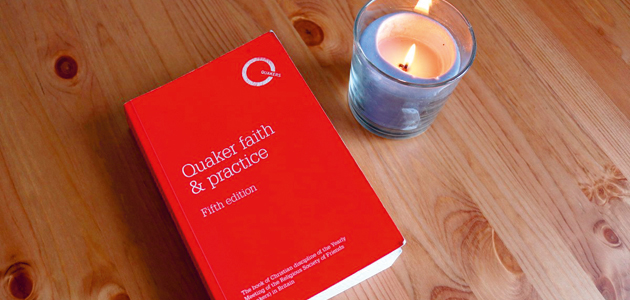
From a local library, I read about 30 faith-based books before I came across Quaker Faith & Practice. When I read the introduction and the first chapter, Advice & Queries, a tingle of excitement ran down my spine. I carried on reading and when I got to the page 'Ways of Seeking' I decided there and then I was going to be a Quaker.
What appealed to me the most is that the Quakers have no creed. There is nothing to say a Quaker must believe this or that. If you believe in God or not, it's your choice. Every Quaker must speak for themselves and seek their own spiritual path.
What binds Quakers together are the testimonies. These are most commonly referred to as SPICES:
Simplicity
Peace
Integretity
Community
Equality
Stewardship / Sustainability
Quakers live their everyday lives through these testimonies, interpreting them as they best see fit.
For me, it is the Equality testimony that I find most powerful. When the Quakers began in mid 17th century England, it was the Church that decided who should and shouldn't receive God's love. The Quakers rejected this and adopted the belief in Universal Love. It may seem strange to think in this day and age, but at the time Universal Love was a highly controversial belief. This was because it took power away from the Church of England who claimed to have the authority, on behalf of God, to say who was and wasn’t worthy. In essence, Universal Love means equality. You have an equal right to love and be loved in return no matter who you are. For me, I find an acceptance within the Quaker community that I've yet to experience elsewhere.
I'm now 43 and have been a Quaker for almost four years. My mental health has improved and I'm probably happier in my own skin than I have ever been.
Today is World Gratitude Day. Gratitude is something that has grown more within me since becoming ill. The small things have become the big things. A cup of coffee, a shower, sitting outside in the sunshine or a visit/message or letter from a friend. These things matter more to me now and I am more thankful for and actually often enjoy more than the big things at times. I think we need more gratitude in our lives and to take a step back and evaluate our lives and what we feel gratitude for and what matters the most to us and makes us the happiest and to help out other people and share kindness and happiness.
It's Tuesday morning, about 11am. For the third time since 7am, the ache pulsing through the right-hand side of my face has turned into indescribable bolts of agony. Some describe it as electric shocks, but today it feels like someone has flipped an "on" switch, activating searing acid trying to destroy my face from the inside out. My teeth and gums are indistinguishable from my jaw and cheekbone. They're one amalgamated plate of pain. I sit on the floor and grip the hair on the other side of my face, incapable of doing anything except scrunching my eyes and whimpering "ow, ow, ow." One of my dogs tries to comfort me by licking the only exposed skin area he can find: that searing side of my face. It's my breaking point. I call my doctor's surgery to tell them I need an urgent telephone appointment. I'm giving in, relinquishing my quality of life to the side effects of the medication that will help.
To some extent, knowing what's happening to me helps. If you put your palm on your ear and splay your fingers out- pinky under the lip, middle finger towards the nose, thumb above the eyebrow-you've got a rough idea of the three nerve branches in your face. Each branch has a few coming off of it, but that three-pronged nerve is where the "trigeminal" in "Trigeminal Neuralgia" comes from. The "neuralgia" is nerve pain. Often, in TN, there's an impingement on that nerve. It can cause misfiring on one, two, or even all three branches. For those whose MRI shows a reason for their pain, a surgery the decompress the nerve puts you out of action for about two weeks, but in return they're likely to have years free of torturous pain. This is more common in TN type 1, which is usually flashes of pain. In type 2 typically has longer periods of pain, more of a "strong, consistently throbbing face ache." This usually doesn't have an obvious cause that can be surgically rectified. People can have both, and often distinguishing between them isn't quite straightforward.
TN used to be referred to as "the suicide disease" because of the intense pain. It is debilitating and exhausting. Those who have been through kidney stones and pregnancy as well as TN agree that TN is by far worse, and harder to treat. Before vaguely effectivetreatments existed, many resorted to suicide. When my flare ups were only occasional, I didn't understand. When I became paralysed by pain repeatedly in the day, I understood. Cold wind on my face was a trigger. So was eating on that side of my mouth, brushing my teeth, blowing my nose, and a plethora of other benign things.
But I'm lucky. My dentist recognised the symptoms and didn't recommend pulling any seemingly healthy teeth to try to resolve the issue. Many others have had multiple teeth removed. Nor have I had to argue with my GP about my symptoms being psychosomatic or a migraine. Neurology advised on medication to start prior to my referral. Others waited months for even this. I'm hoping that an obvious physical cause will be found so I can have a long-term intervention instead of dulled pain, nausea, and thrice daily naps courtesy of my current medication.
Pacing can be used by anyone living with a chronic illness/disability. Pacing is helping you to keep a healthy balance between activity and rest by spacing out activities during the day. It enables us to take better control of our health and stay with our body's limits, even when we are unwell, and become experts in managing our health and life better and prevent exacerbating symptoms, or even causing a crash or relapse. Though learning how to pace ourselves in can bring improvements in the way we feel and whilst it does take a lot of patience and self-control to learn how to do it in time most people are able to do more. Learning how to pace ourselves allows us to gain a better awareness of our own limitations which allows us to better manage our energy levels and maximise what we are able to to on a daily basis. It does take a bit of practise and work (and I'm still learning and improving myself) but once you've mastered it it will significantly help you manage your health.
With he traffic light system it gives you a visual way of balancing activities to help you maintain your energy levels. and plan your day (for planning see below).
Greenare easy tasks/activities Orangeare okay tasks/activities Redare challenging tasks/activities So with the traffic light system if you were to do a red task on your 'to do' you know to follow it by a green task or a period of rest so as to avoid overdoing yourself and making your symptoms worse allowing you carry on throughout day. What is so good about the traffic light system is that you can adjust it for how you are feeling that day. So on a good day making a telephone call may be a green task, but one another day where you're running low of energy or you're feeling anxious making a telephone call may be an orange task. What you label as red, orange and green is individual to you. Alternatively you could label green could also be labelled as rest, orange for low energy activities and red for high energy activities. On bad days is is best to do more green and orange activities and if possible avoid red activities.
20:10 is another easy way to get a balance of activity and rest in your day. It basically entails 20 minutes of activities followed by 10 minutes of rest. On a bad day you could swap this around and do 20 minutes of rest and 10 minutes of activity or whatever is manageable for you.
What is 'Activity'?
An activity is anything that uses up our energy, it may be physical, cognitive or emotional energy; basically nothing that is not complete rest. This could be anything from baking a cake, laying down listening to an audiobook and even getting upset or being in pain. Using a balanced and steady approach towards activities prevents the tendency to overdo things which leads to an inevitable crash, relapse or exacerbation in symptoms.
Planning
Planning your day out is also a really important so you can spread out and use your energy wisely. You can use analogies such as 'Spoon Theory' to help you plan out your day and where to spend your energy of 'spoons'. When planning what actives that you will do that day think it's important to categorise activities such as: physical, cognitive, high energy and low energy. This is where the traffic light system can be useful. On bad days you should aim to do more green and orange activities.
I find using my pacing whiteboard and post-in notes really helpful to plan my day out, and if I do find myself running out of energy I can always rearrange the magnets to something that will be more manageable for the rest of the day. It's also a great visual tool, especially to colour coding (and I couldn't resist buying coloured whiteboard pens too!).
My whiteboard plan for the day using the Traffic Light system
Set yourself some reasonable and manageable goals for the day, like getting dressed, washing your face and spending some time out in the garden. Whatever is manageable for you to do on that given day.
Remember, it's okay to have bad days and it's okay to do little on those bad days.
To manage activities effectivity you need to listen to your body and work out how long you are able to do an activity for - this is your baseline. Your baseline is the amount of one activity you can do consistently without your health worsening. When you know your baseline you can know better your limits for good and bad days.
Everyone's baseline is different and how long one person can do a particular activity for differs for someone else.
When working out your baseline it's important not to make your symptoms worse. It may be help to keep a diary of your activities each day and note how long you was able to do that activity for to help you work out what your average baseline is. When taking your notes also make a note of your emotions as that can affect or energy levels as well as other notes such as your level of pain that day and breaking activities down with periods of rest. Slowly you will grade yourself up to increase the time you spend on an activity. When you listen to your body and let it guide you as to what activities you are able to do when; when you feel able to do something or not do something
And remember, it's okay to ask for help.
Switching
Switching is an important aspect of activity management. Often when you have a chronic illness/disability focussing on the same activity repeatedly during the day can exacerbate and make symptoms worse.
By doing different activities during the day can mean you are able to do more.
So switching could involve watching TV followed by making and eating lunch followed by doing your physiotherapy exercise followed by sitting in the garden with a hot drink. Doing this means you are doing a variety of different types of activity - cognitive, physical, high and low energy. Also, don't forget to plan in rest periods too.
Prioritising
Try to prioritise the most important tasks and remember that there is always tomorrow. I find writing colour coded lists helps or using my reminders app which sync across my mobile, laptop and iPad helpful. You could carry a little list book or diary around with you or get a pack of differently coloured post-it notes. When writing your 'to do' list or plan for the day make not of what actions have the most urgency, such as ordering medication you're running out of. It might help to number your list from 1 being to most important so you know that action needs to upmost attention so you can get them done first before your batteries start to run low. If you're going through a rough time with your health and you have a lot of appointments it might also help to prioritise your appointments (this is something I've been doing lately). Look at what appointments you have, what appoints are important or can't be changed and what appoints can be postponed to a later date so as to give you more time to rest and recuperate.
What exactly is rest?
Often we think that resting is laid watching TV or listening to music, and even though we are physically resting we are still actually stimulating our minds by using up cognitive energy - such as having to concentrate on the story line and listen to what is being said. Complete rest means having no stimulus around us ignorer for our brains to rest. No sound, light, smells etc. To help you have complete rest you can put on an eye mask and use ear plugs or noise cancelling headphones/ear defenders. Whist resting you may try out breathing exercises, meditation or other things like visualisation. This type of 'neurological rest' allows or bodies and minds to recharge better. When you have a chronic illness/disability, especially if you struggle with chronic fatigue having regular periods of rest or relaxation during the day is important when it comes to pacing. Remember: never feel guilty for resting.
To sleep or not to sleep?
Some healthcare professionals say the having a sleep during the day can help to get better sleep as bedtime as this prevents getting over tired at bedtime resulting in difficulties getting off to sleep.
Some experts say they you should not sleep after 3pm.
Other professionals contridict this and say it is not necessary to sleep during the day and daytime sleeping can affect sleep quality at night.
I think its about really listening to your body. If it get to after lunch and your body just can't function without a nap then have a nap and then you can gradually build yourself up from sleeping during the day to just having a period of complete rest. (Since reading about this doing this post I've been having a rest/nap in the afternoon and I have found benefit from this.)
I've written about migraines before but that was more of an info/awareness post so because of my frequent migraines I thought I'd write a list of some of my personal migraines essentials which you might find helpful. Everyone's unique and have their own personal essentials and tips and tricks but here are a few of mine...
Dimmable lights
Cooling forehead pad/cold wet flannel or forehead roll-ons
Eye masks - I either use a cotton or I have another which has a gel insert which I can pop in the fridge
Comfortable noise cancelling headphones or ear defenders/ear plugs
Whatever medication you need and take for your migraines and for pain relief and anti-sickness
Big tumbler of water/juice to keep your fluid intake up and with ice cubes in
Plenty of cushions and pillows to get you into a comfortable and supportive position
Pjs, (because they're more comfortable and lighter to wear)
It's currently Migraine Awareness Week in the UK. Today 190,000 people in the U will have had a migraine - myself included. Migraines are something I battle with a lot! I have Chronic Daily Headaches/Chronic Migraines as well as Migraines with an Aura and the rarer Hemiplegic Migraines. At the moment I've had an ongoing migraine for almost two weeks now and it's no fun at all. For me migraines are just part of my life and I have learnt to live with them. Somedays I can about function near enough normally whilst having a migraine which can be quite deceptive, like Have a migraine now but I'm able to blog now (just in a dimmed room with a dimmed screen and tinted lenses). Other days I feel incredibly ill and like my head is being crushed and I can barely talk or function. They are not something I would wish upon anyone. With bad migraine days even simple tasks can be painful and difficult. When I have a migraine I have to take lots of different medications to try to relieve my migraine: Sumatriptan (triptans are migraine prevention medications), pain relief medications and antiemetic (anti sickness) medication. Unfortunately theses things don't completely stop or cure my migraines, they just give me a little relief. One day I hope a cure for migraines can be found, but so far there is only prevention and management of migraines. So for the meantime people like me must just try our best to cope as best we can.
What is a Migraine?
A migraine is much more than 'just a bad headache'. They are a complex neurological condition which come with a wide variety of symptoms. There are also many different types of migraines and there's no such thing as a 'typical migraine', so what a person experiences or is a migraine trigger will be completely different for another person, even if they are experiencing the same type of migraine - confusing or what?! The cause of migraines are unknown but it is believed that migraines have an underlying genetic factor and women are more affected than men.
In the UK migraines affect around 9 million people, they affect some people more often than others. Some people may just have a few migraines in their lifetime, but other people like myself it's not uncommon to have several migraine attacks a week.
When a person is experiencing a migraine it is referred to as a 'Migraine Attack'. Migraines can last from anything from a few hours to a few days.
The term 'Chronic Migraines refers to when a person has 15 or more migraine attacks a month.
Migraine Symptoms and Stages
These vary depending on the type of migraine but some common migraine symptoms include:
A migraine can present as a painful headache alongside other symptoms including
Pain in the head
Visual disturbances
Sensitivity to sound, light and smalls
Nausea and vomiting
Fatigue/lethargy
It's had to predict a lot of the time when a migraine will hit. However migraines follow a sort-of set of stages:
1. Prodrome or pre-warning stage.
In around 60% of people with migraines they will have a pre-warning stage. This stage is difficult to work out as to whether you're going to have a migraine or if your just feeling unwell. Symptoms may include mood swings, fatigue, muscle stiffness and hypersensitivity.
For me I get quite confused, irritable and difficulty concentrating, I get spinal/neck pain (that spot where your spine meets your head like I have now), throbbing temples, hypersensitivity and visual disturbances.
2. Aura
This stage doesn't happen in people who have Migraines without and Aura.
This stage includes a wide variety of neurological symptoms. This stage usually lasts from 5 minutes to an hour. They usual happen before the migraine but for some the storms can last during the migraine too.
For me especially the visual changes an speech problems last longer for me.
It is caused by changes the cortex are of the brain.
Some people may experience visual disturbances.
Other visual disturbances may include seeing dark or coloured spots, stars or zig-zag lines. There may also be numbness or pins-and-needles, muscle weakness, dizziness. A person's speech and hearing can also be affected. Memory changes can also happen, such as feeing dread, confused.
For it's like I'm seeing the Northern Lights in front of me, I can slur, forget or stumble on words and sounds gets muffled or I get a dull ringing in my ears. I also get a feeling of dread and confused.
I also have a rare type of migraine called Hemiplegic Migraines where I get numbness/weakness, pins-and-needles and speech loss and down one side of my body (symptoms very similar to a stroke) but thankfully these systems ease of after a while.
3. The headache or 'main attack'
This part is 'the headache' which can involve different types of head pain typically throbbing and made worse my moving your head. The pain can also feel like a pressure in your head like a crushing sensation.
Pain can be from moderate to severe to unbearable (the the point you which you didn't have a head!)
The pain is usually on one side of the head, button always.
The pain builds up gradually and is made worse by physical activity. So this is the time to stop, lay down and rest.
As well as the pain other syomtoms may include hypersensitivity, fatigue, dizziness/diorientation and mood changes.
In my aura stage I also get nauseous but when I have the headache the nausea worsens sometimes to the post I'm actually vomiting, probably due to the pain. My hypersensitivity can also worsen.
This stage can last from a few hours to several day, sometime longer for some people.
Resolution
Most migraines slowly fade away, bu in some cases they may suddenly stop after a person is sick or cries a lot. Sleep may help a lot of people and can help the person to overcome their migraine.
4. Postdrome or recovery
This is a big like a 'migraine hangover' once to he ache has settled which can make hours or days to overcome. Symptoms can be similar to the first prodrome stage.
Types of migraines
Migraine without an aura - this is the most common type of migraine affecting around 70-90% of migraine suffers
Migraine with an aura - a common type of migraine with additional neurological symptoms
Chronic migraines - this is the name given the you have 15 or more migraines a month and recently defined sub-type of Chronic Daily Headache This affects less than 1% of people so yay me, not!


 Emotional Self-Care

 Intellectual Self-Care

 Social Self-Care

 Environmental Self-Care


 Financial Self-Care